In the fall of 2025, commercial Realtor David Lefemine stood outside a 105-year-old cinderblock building at West Walnut and Sevier streets. It was the former Robinson Plumbing building at 501 W. Walnut St. He told WJHL that people on a nearby patio would sometimes watch him finish a showing and then walk over to ask about the building. The building had been bought in 2020 for $225,000 and was listed at $625,000. It sold on Feb. 27, 2026, for $550,000.
Lefemine told WJHL that 31 properties on that short stretch had sold over the previous six years. He said land that went for about $600,000 an acre six years earlier had moved to $800,000, and two recent deals had topped $1 million an acre. If you're thinking about buying one of the century-old houses in the Tree Streets, just south of that corridor, those are the figures you'll hear first. They describe commercial ground along Walnut. The house you'd buy is priced in the region's residential market, and that market slowed this fall. In the Tree Streets, the lot and the house set the value. The street a block away doesn't.
The corridor and the houses behind it
The West Walnut redevelopment covers the stretch between downtown at Buffalo Street and East Tennessee State University at University Parkway. It also includes about half a mile of Ashe Street across State of Franklin Road from Founders Park. Planning started around 2017, and construction took four years. Lefemine said residents and business owners both gave input along the way. WJHL noted that the residential Tree Streets border the corridor on the south.
What buyers on Walnut are paying for is old industrial buildings and the land under them. Lefemine expects many of those buyers to keep the industrial look for restaurants, microbreweries and shops, and he said some developers have looked at five- and six-story towers on the north side of the street.
South of Walnut, the Tree Streets are a locally designated Conservation District within the larger Southside neighborhood. The city's Tree Streets design guidelines count about 225 mostly residential structures, built mainly between 1900 and 1940. The district is generally bounded by Lynn Street, University Parkway, and the property lines south of Cedar Place, Locust, Devine, Sevier, Lynn and Earnest streets. The broader South Side area became a National Historic District in 1996. The local guidelines were first adopted in 1999, amended in 2012, and taken up for a major rewrite beginning in 2021.
Two plats, a porch, and the exterior you inherit
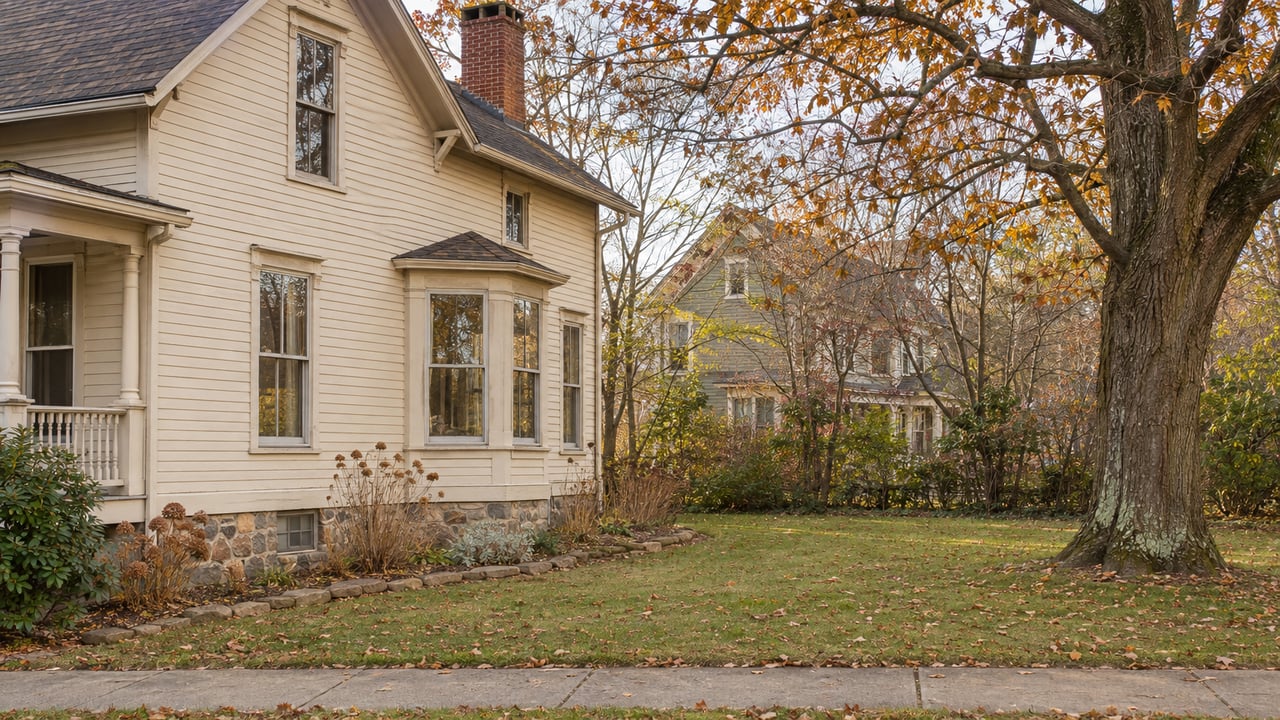
Most Tree Streets houses are around a century old, and the lot is a bigger part of the purchase than it would be in a newer subdivision. According to the city's guidelines, district lots were originally platted 25 feet wide by 135 to 145 feet deep. Most houses sit on two plats, and some sit on three or four. The streets are narrow, the lots are small, and the setbacks are shallow, so houses sit close to the sidewalk and close to each other. A house on three plats has noticeably more yard than a neighbor on two.
The city lists Bungalow/Craftsman, Queen Anne, Four Square and Colonial Revival as the district's most architecturally significant styles. L-plan houses, I-houses and later period-revival homes are mixed in among them. Two homes on the same block can be very different purchases. One might be a Craftsman bungalow with its original porch. The next might be a Four Square that already went through a round of exterior changes before you saw it.
For a house this age, the porch, windows, siding and trim carry much of the character and much of the upkeep. Lefemine was talking about the industrial buildings on Walnut when he told WJHL that "you couldn't create the atmosphere that's in these buildings; it would maybe cost you a fortune to recreate what's already there." The same thinking applies to a 1920s porch. An original one in good repair is part of what you're paying for, and one that needs rebuilding belongs in your offer math.
The walk is what changed
What the corridor did change for Tree Streets owners is what's within walking distance. A Johnson City news release from Oct. 20, 2025, listed what the West Walnut work delivered: a pedestrian-oriented streetscape, on-street parking, a dedicated bike lane, utility and sidewalk upgrades, and traffic-calming features. Lefemine described retro street lights, heavy landscaping, pavers at each intersection, and power lines moved underground.
From a Tree Streets porch, the destinations are a short walk. The Firehouse Restaurant and Groovy Grover's were already open on West Walnut when the corridor reopened. The Johnson City Press reported in January 2026 that Main Street Pizza had announced a move into the unoccupied side of the Groovy Grover's building at 426 W. Walnut, with indoor seating for 88 and a target opening last spring. Fearless Coffee & Kitchen is at 500 W. Walnut, and Bebettes is at 811 W. Walnut. For parks, there's Powell Square Park at 201 W. Poplar Street, Kiwanis Park at 821 West Market Street, and Founders Park at 225 S. Commerce Street, across State of Franklin from the corridor's east end. Carver Recreation Center at 322 W. Watauga Avenue has been in its current building since 2005.
The neighborhood's own calendar keeps going too. The city repaved the Tree Streets starting July 6, 2026. On Sept. 12, 2026, the Southside Neighborhood Organization held its annual Tree Streets yard sale. WJHL reported that the proceeds help support the historic district.
The corridor will keep changing for years. In September 2025, the city had cleared the former Copy Net property at 420 Ashe Street, a little over an acre, and was preparing to look for a developer for a mixed-use project with retail, residential and parking. Assistant City Manager Alicia Summers told WJHL that downtown's revitalization started around 2008 and is still going, and she expects West Walnut to follow "that same timeline." If you buy a Tree Streets house now, the corridor will keep adding storefronts while you live there.
The residential market behind the corridor has slowed
The Tree Streets house is priced in the region's residential market, which had more homes for sale and a slower pace this fall. The Northeast Tennessee Association of Realtors' September 2026 report covers Northeast Tennessee and Southwest Virginia together. It counted 717 closed sales in September, up 0.7% from September 2025. The September median sale price was $290,000, down 1.69% from a year earlier. The region had 2,880 homes on the market in September, 7% more than a year before, and 984 new listings that month. Median time on market was 74 days in September, up from 70 days a year earlier.
Borrowing costs more this fall. NETAR cited Freddie Mac's average 30-year fixed rate of 7.4% for the week ending Oct. 8, compared with about 6.3% a year earlier. NETAR estimated the difference at roughly $220 a month in principal and interest on a $300,000 mortgage. Those figures are general information, not financial advice, so please confirm your own numbers with your lender. NETAR's Nov. 15 column said some buyers are waiting for rates to come down, and some owners with low-rate mortgages are reluctant to sell. It also said prices can vary within a single neighborhood depending on a home's condition, location and features.
That last point fits the Tree Streets well. The houses are close to a hundred years old, sit on different numbers of plats, and have been looked after differently over the decades, so two of them a block apart can sell for quite different prices. A slower market with more listings gives you time to look closely. You can bring in an inspector who knows older houses, price out the exterior work you have in mind before you're under contract, and compare one Four Square against another instead of against a brand-new house on the edge of town. If low maintenance is near the top of your list, our guide to choosing a low-maintenance home in Johnson City covers that side of the decision, and the Johnson City neighborhood page has more on the rest of town.
A Tree Streets purchase comes down to two questions: how many plats the house sits on, and what shape its exterior is in. If you're weighing a house there, or getting ready to sell one your family has owned for decades, Kristi Bailey will walk the lot with you, look at the house the way a careful inspector will, and help you put a fair price on what's there. Let's Talk About Your Move.